

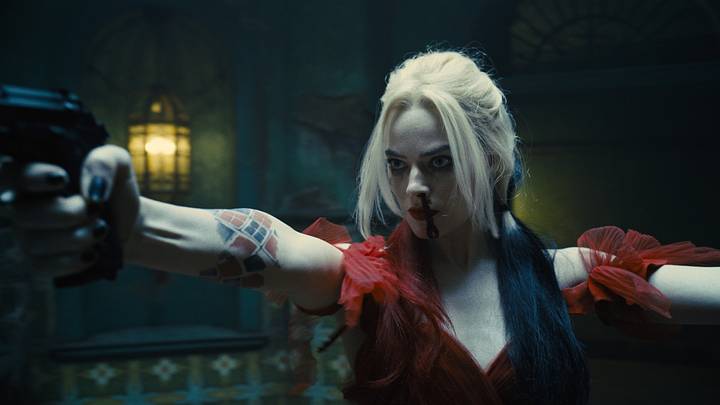
The fallout of James Gunn’s departure from DC Studios still needs time to settle, but this latest consequence of the Skydance takeover puts the brand in all-too-familiar territory: total upheaval and corporate chaos. What’s more, there is a familiar assumption. When the new brass hand-picked by Skydance CEO David Ellison assumes their position of power and influence in Burbank, the knee-jerk remedial tactic expected is going scorched-earth again with another reboot—the fourth consecutive or so in a decade.
A few actors were there for every transition, and one major star stood completely insulated amid the rubble of scrapped slates, abandoned continuity, and regime change. Despite starring in The Suicide Squad, Margot Robbie’s Harley Quinn is not a product of Gunn’s wacky ensembles, and his exit alongside Peter Safran might actually clear the runway for her return.
Remember, Robbie wasn’t tethered to Gunn’s tenure at any point—pre- or post-studio executive privilege. Even a cursory check of the receipts shows he didn’t discover or cast Robbie, nor did Gunn shape Robbie’s culturally impactful take on the kooky anti-heroine. No, director David Ayer brought her into the fold for 2016’s "The"—deficient Suicide Squad. The film was an unmitigated mess, and the studio chopped it up and tossed it around like chef salad. Still, Robbie became an undeniable breakout star everyone wanted to imitate—and dress as for Halloween.
The turn that came years later, in 2020’s Birds of Prey, had nothing to do with Gunn either. As a co-producer and star, Robbie championed and owned a new neon-soaked corner of Gotham. Though she shared the turf and credit with Mary Elizabeth Winstead’s Huntress, Jurnee Smollett’s Black Canary, Rosie Perez’s Renee Montoya, and director Cathy Yan, the “Emancipation” was truly all her own.
When Gunn directed Robbie, it seemed less like a creative rebirth and more like the next consecutive act of playtime in a sandbox she already built from the ground up. Robbie was cementing a legacy and reasserting her dominance according to her version of Gunn’s battle plan. He gave orders, but she brought her usual charm to carry them out.
Harley is hers, through and through, as Gunn recently admitted. Right before his ouster, he confessed that her future as Joker’s former flame is in her hands, not his. The new regime would need to approve, but Robbie’s status as a legacy predating Gunn’s experiment at least incentivizes their consideration.
New leadership trying to right a ship and mend a fractured brand should welcome the chance to bring back a fan-favorite portrayal. New regimes crave immediate wins and recognizable faces to anchor shaky transitions, and those in the annals of comic book cinema embodied a role as effortlessly as among rarefied air.
The real obstacle to her homecoming isn’t studio politics or the headaches of straightening out continuity; it’s Robbie’s stratospheric trajectory after Barbie. Since the Mattel adaptation blossomed into a billion-dollar cultural phenomenon, she ascended to the figurative penthouse.
Between commanding top-dollar paychecks as one of the industry’s highest-paid actresses, steering more massive adaptations with her production company LuckyChap, including Sims and Monopoly, and balancing motherhood, Robbie doesn’t need capes and spandex to validate her if she is not inclined. If she is, her return won’t hinge on an obligation to a contract, continuity, or a single filmmaker. The door remains open as long as she wants to play.
 Add us as a preferred source on Google