

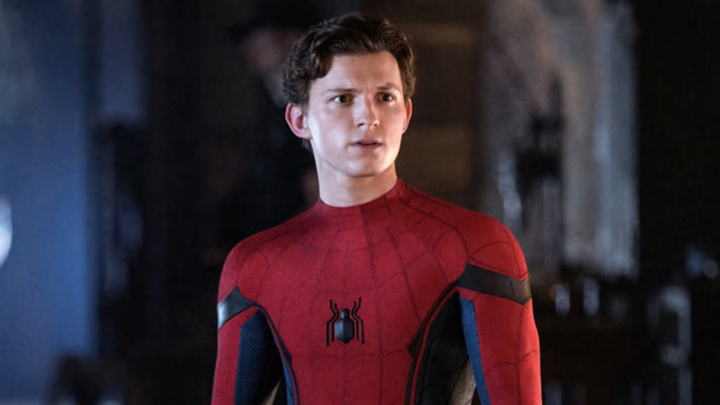
We all know how the story goes. A brilliant yet timid teenager called Peter Parker is suddenly bitten by a radioactive spider, and his life changes in a heartbeat. Suddenly, his bad luck seems to go away, but the golden days are quick to end when a regular burglar kills his uncle. Since that very moment, Peter learns that with great power comes great responsibility, and he becomes Spider-Man. Despite that, we've yet to dive into the hero's iconic origin story in the Marvel Cinematic Universe.
By the time Tom Holland took over the Spider-Man mantle, audiences had already seen two different iterations of the character on the big screen, each with its own origin story. Since it would have been a little derivative to do the same thing for a third time in a row, the MCU decided to skip the formalities and jump straight into action. But an entire trilogy later, it might be finally time to revisit Peter's past and discover the backstory behind the radioactive spider that bit him. Much to our surprise, another big hero might've been involved in the experiments that changed Peter's life.
Bruce Banner might be behind the radioactive spider that created Spider-Man in the MCU
Ever since it was announced that Hulk would appear in Spider-Man: Brand New Day, fans have wondered what role he would play. Among all the MCU characters in existence, why Bruce Banner? After all, it would be more natural to see Peter paired with either Matt Murdock or Johnny Storm, as it has happened countless times in comic book pages. But, at long last, we might know why such a creative choice was made.

Renowned insider Alex Perez addressed Hulk's upcoming role by posting a very cryptic picture that details the history behind the Super Soldier program in the early 2000s. General Thaddeus Ross reactivated the program with the hopes of turning "ordinary humans into super soldiers". Both Betty Ross and Bruce Banner were recruited to accomplish this mission, though the latter believed that his research was simply on "radiation resistance". When Bruce finally learned the truth behind the program, it was already too late, as he was exposed to great doses of Gamma Radiation that turned him into a green rampaging monster.
The post itself doesn't reveal any new tidbit of information on its own. However, it does imply that Bruce's role in Spider-Man: Brand New Day will tie back to the Super Soldier program and the research he conducted on radiation. And since the bite of a radioactive spider granted Peter Parker his superpowers, it wouldn't be too far-fetched to assume that Banner was unknowingly complicit in changing Peter Parker's life. At long last, Spidey could better understand his own origin story.
Interestingly enough, it has been reported that Savage Hulk will finally be unleashed in Spider-Man: Brand New Day. If, for some reason, Bruce were to revisit his research on Gamma Radiation, chances are that the experiment could go wrong once again. That would explain why we'll see an even more unhinged and violent version of the Green Goliath.
The Amazing Spider-Man franchise tried to explore the origins behind the spider that gave the wall-crawler his powers, but it did so in a way that contradicted the idea that anyone could be behind the mask. In Andrew Garfield's story, it was explained that Peter's father encoded his own DNA in the radioactive spiders, so only Peter's blood would react to it. However, it seems the MCU will avoid this by explaining the spider could've bitten anyone, even if Bruce was behind its creation.
The idea of exploring Peter's backstory in the MCU is certainly interesting, especially if Hulk had a role to play in it. Fortunately, we aren't too far away from getting some concrete answers.
Spider-Man: Brand New Day will be released on July 31, 2026.
 Add us as a preferred source on Google