

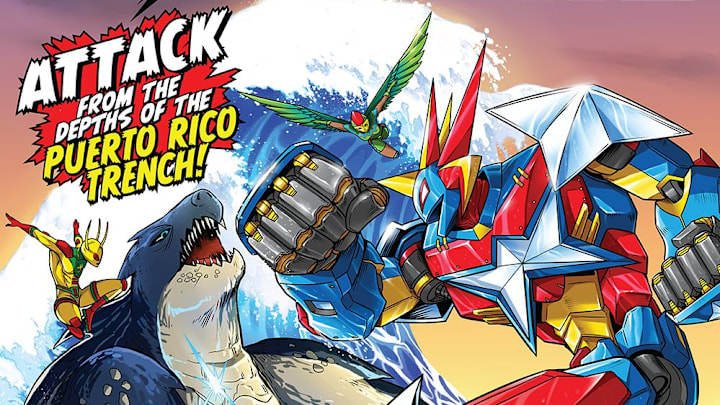
Back in 2016, the world witnessed the comic book debut of La Borinqueña—a Puerto Rican superhero who proved that sometimes the best superpower you can have is your own cultural heritage. A decade later, the world created by graphic novelist Edgardo Miranda-Rodriguez is expanding not only in scope but also beyond real-life frontiers. What would happen if you were to combine iconic Puerto Rican characters with Japanese mechas and kaiju? Well, the result would be none other than V•G1GANTE No. 1.
This one-shot manga keeps the identity of the La Borinqueña universe intact while simultaneously taking the visuals in a new direction never before seen in the franchise. Illustrator Hernán Castellanos did a flawless job of creating a beautiful manga art style that feels inspired by iconic Japanese artists such as Go Nagai. Furthermore, colorist Eliana Falcón-Dvorsky used a light color palette that adds a slight retro look to this book, which is nothing short of mesmerizing.
If you were to strip V•G1GANTE No. 1 of its dialogue and storyline, it would still be worth it based on the art alone. The character's expressions, the lighting in every room, and the action sequences all come to life in great detail and with a lot of style. It's only fitting that a lot of the issue focuses on the sentient mecha V•G1GANTE fighting a kaiju named Caguama. This confrontation creates a lot of spectacle for readers to behold, and it all comes together flawlessly thanks to the care put into crafting every single panel.

Of course, one of the main hooks of the La Borinqueña universe is its colorful characters that don't shy away from their roots. This time, the spotlight is on Brismar Besosa Crúz, a computer science undergraduate who, despite having superpowers, faces the same problems as any other student.
In the few moments V•G1GANTE No. 1 stays away from big action set pieces, we see Brismar struggle to pay her tuition and decide how to handle the situation. She wants to set an example for other students by trying to solve all her problems on her own, even if it is the hardest path to take. Eventually, she accepts help from her family, which ties nicely into the themes of community and collaboration that the La Borinqueña universe is widely known for.
While Brismar's future is still a bit uncertain by the end, it doesn't feel as bleak with someone else by her side. It's worth noting that the saga not only aims to raise Latino representation in the superhero world but also to help others in real life (as a portion of the comic book's sales support non-profit organizations in Puerto Rico). With that in mind, it's nice that one of the central conflicts of V•G1GANTE No. 1 is solved by the main character accepting the help of others when she needs it the most. The book does a fantastic job of balancing these personal moments and real-life problems with the big action set pieces, which is what every great superhero tale should aim to do.
As a newcomer to the La Borinqueña universe, I was surprised to see how much Spanglish was used throughout the dialogue of V•G1GANTE No. 1. Granted, if you're familiar with the franchise, this is old news. However, it must be said that the frequent combination of the two languages adds a nice touch of personality that isn't found anywhere else. Sure, we might see the occasional Spanish dialogue in a Miles Morales comic book, but they tend to lack idioms or expressions specific to Puerto Rico. Fortunately, things are different here, and it is for the best.
But while it was a joy to be a newcomer discovering the extensive amount of Spanglish used in the La Borinqueña universe, the lore didn't treat me so kindly at first. I went into V•G1GANTE No. 1 completely blind, and even when the book attempts to bring you up to speed with previous events, some questions remained unanswered until I read the original La Borinqueña series. As a whole, the franchise has an interesting and well-crafted story rooted in the Taíno mythology. However, V•G1GANTE No. 1 feels more like a sequel than a stand-alone manga that could act as an ideal entry point to the saga. There are some twists and turns that only fans familiar with the franchise will truly appreciate.
We also need to address the bane of every writer's existence: dropping a lot of exposition in a way that feels natural. The opening dialogue of V•G1GANTE No. 1 is clearly made with the sole purpose of recapping previous events in the La Borinqueña universe. However, it can feel unnatural as a result. Mr. Rios, the head of the evil corporation Dulcinea Laboratories, finds himself asking many questions to which he already knows the answers. This is to ensure readers can go over previous events in a short span, but the book's opening conversation feels a little clunky as a result.
Besides these minor problems, V•G1GANTE No. 1 delivers on all fronts: it has colorful characters with relatable struggles, features a mesmerizing Japanese-inspired art style that looks beautiful in every single panel, raises awareness of problems related to Puerto Rico's struggling economy, and the ending leaves room for a follow-up further down the line. Granted, this isn't an ideal entry point to the La Borinqueña universe, and the dialogue can be awkward in the book's opening moments. But this book has ambitions of kaiju proportions, and it swiftly succeeds in bringing most of them to life.
"V•G1GANTE is inspired by the vejigante folkloric papier mache masks of Ponce, Puerto Rico and the Japanese giant mechas, bringing together for the first time a sancocho of Latiné and Asian art mediums and genres. This new book also continues to expand the decade long overarching La Borinqueña story first introduced in 2016 that already has expanded its universe to include a crossover with DC Comics, a team-up with actor/activist Rosario Dawson, and two new spin-off superhero books Oro El Coqui Dorado and Lúz La Luminosa."
 Add us as a preferred source on Google