

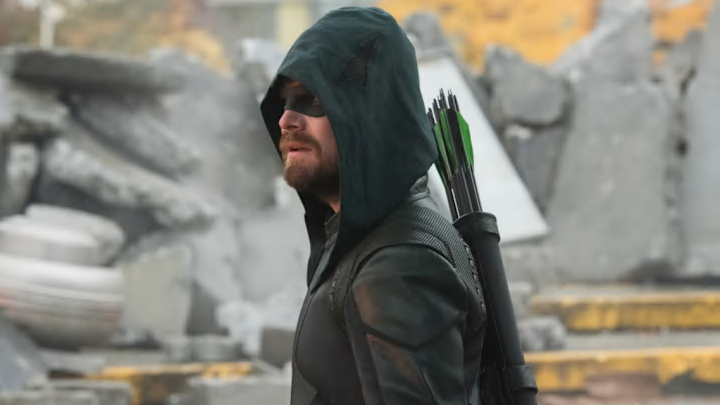
If you didn't know, the 2010s were an insane time to be a DC fan. It's true; DC superheroes were everywhere, delivering high-energy, non-stop action on the small screen. And we owe a large portion of that legendary era to Arrow.
Premiering on The CW in 2012, Arrow starred Stephen Amell as a darker, grittier version of the emerald archer known as the Green Arrow. The success of billionaire Oliver Queen's late-night escapades launched a shared universe of superheroes that could rival the expansive nature of Marvel's legendary MCU. Affectionately known as the Arrowverse, it produced a multitude of spinoffs, crossovers, and iconic moments that pushed the boundaries of broadcast TV - making memories for DC Comics fans all over the world.
Arrow's time on our screens would come to an end in 2020 when the show aired its season 8 - and series - finale. Although the CW franchise was still thriving, the time had come to bid farewell to the originator of our favorite TV superheroes. Here's why.
Stephen Amell wanted Arrow to go out on a high
Although Arrow would likely have been renewed for a ninth season by The CW, star Stephen Amell made the difficult decision to exit the series. He had planned to bow out whenever his contract ended with the seventh season, but he revealed via a Facebook Live video shortly after the show's conclusion was announced that he felt season 8 would be a good time to go as it would have allowed all involved to go out on a high.
As for what went into this decision, he revealed that - having grown up so much throughout the show's decade-long run - he wanted to be able to spend more time with his family. Arrow, along with the majority of the other DC TV shows - filmed in Vancouver for 8 - 10 months of the calendar year, meaning that most of the actors had to live there during that time (which, of course, results in spending time apart from your family). Amell showed interest in having a home outside of Vancouver.

He also said that, upon approaching Greg Berlanti about this decision, he wanted to make it clear that he didn't want the show to "overstay its welcome". Eight seasons is a long run and, we've seen on many occasions throughout TV history, that a show can lose its way if it's on the air for too long.
But Amell was absolutely right when he said that the show would be going out on a high. Season 8 is widely considered one of Arrow's best seasons, largely due to its episodic nature - that both allowed it to pay tribute to different elements of the show with each episode and set up the Crisis On Infinite Earths crossover extremely well. It also placed the focus on the show's original trinity of actors in Amell, Katie Cassidy, and David Ramsey, allowing it to end in the same strong place that it started in.
Considering Arrow had plenty of ups and downs throughout its run, ending on one of its highest highs was undoubtedly the right way to go.
Ratings were declining over time
Although ratings weren't a factor in the decision to end Arrow, the show was experincing the general decline in viewership that happens to all long-running shows. With us entering into the streaming era in its final few seasons, those numbers would have continued to decline. Thus, it was wise to end the show when it still pulling in nearly 1 million viewing figures on a weekly basis.
Arrow premiered on The CW in 2012 with a whopping 4.14 million viewers, resulting in one of the network's most-watched broadcasts of all time. It concluded in 2020, with the season 8 finale drawing in 730,000 viewers. Of course, there is a lot to take into account there. Alongside the explosion of streaming in the later 2010s, Arrow lost a huge portion of its viewership throughout tis critically-reviled fourth season, both due to the melancholic drama between Oliver and Felicity Smoak (a character fans had grown weary of) and the baffling decision to kill off comic book royalty like the Black Canary.

The show recovered from season 4 and the ratings steadied, but the sharper decline did result in Arrow losing some momentum - momentum that its spinoff, The Flash, was full of. Impressively, it still managed to produce two of its strongest seasons (season 5 and season 8) before it bowed out, which did renew some interest in it.
Arrow's decision to bow out when it did prevented it from facing the same issues that many of its own spinoffs did, as the likes of The Flash, Supergirl, Black Lightning, Batwoman, and DC's Legends of Tomorrow all faced ratings drops that took them to 500K or below throughout their final few seasons. This was less of a reflection of those shows and more of an indicator that people were either catching up or streaming them instead, but it is a reminder that Arrow got out before that ever truly became an issue for it.
A new wave of second-generation Arrowverse offshoots
As Arrow ended, The CW became home to a number of newer DC TV shows starring characters that existed on parallel earths. With shorter episode counts, high production values and less episodic storylines, they looked and felt like they belonged on streaming. And, in many ways, that's because the first of them was made for streaming.
DC's Stargirl was originally produced for the short-lived DC Universe streaming service, but The CW decided to pick up the broadcast rights due to the network's invested superhero audience. And with that, Stargirl was able to be incorporated into the Arrowverse's Crisis On Infinite Earths crossover as taking place on a parallel earth. So, when the DC Universe went under, The CW was able to officially pick it up as a TV series for two more seasons, welcoming it under the DC TV franchise banner.

After that came Superman and Lois, which saw Tyler Hoechlin and Elizabeth Tulloch reprise their roles as the Man of Steel and Lois Lane, playing alternate versions of their Supergirl characters. It was a more serious, high-quality series that steered clear of the villain-of-the-week format that featured cinematic visuals and more dramatic storylines. Like Stargirl, it felt like a film. And that was, in many ways, set to be the next era of the Arrowverse - which would have been ironic considering that it was Arrowverse-adjacent.
But Arrow's legacy would have continued in the planned Green Arrow and the Canaries spinoff which ultimately didn't go ahead due to the pandemic. It was set to feature Arrow veteran Katie Cassidy, Juliana Harkavy, and Katherine McNamara, telling a story set 20 years in the future of Star City, and t would have focused on the trio of heroes stopping a new wave of crime after two decades of peace.
As Arrow, The Flash, Legends of Tomorrow, and Supergirl were getting older, The CW had begun investing in a new era of DC TV content that could match the streaming era that was quickly taking over television. It would have featured higher-quality production values, more long-term storytelling, movie-level special effects, and less episodes to make each series more digestible.

In the end, that era didn't last long as both the Warner Bros./Discovery merger and The CW's sale to Nexstar resulted in the end of the Arrowverse as a whole. After Arrow, Black Lightning, and Supergirl ended on their own terms, these events resulted in the cancellations of Batwoman, DC's Legends of Tomorrow and adjacent DC series Stargirl and Naomi. The Flash was renewed for a final season and Superman and Lois managed to run for two more seasons (bringing its total run to four seasons) before it too concluded.
Although Arrow season 9 never happened, Stephen Amell did manage to return to the Arrowverse one more time before its conclusion, making a special appearance in the final season of The Flash - teaming with his best friend Barry Allen one more time. And what a beautiful way to end an incredible run as the Emerald Archer.
 Add us as a preferred source on Google