

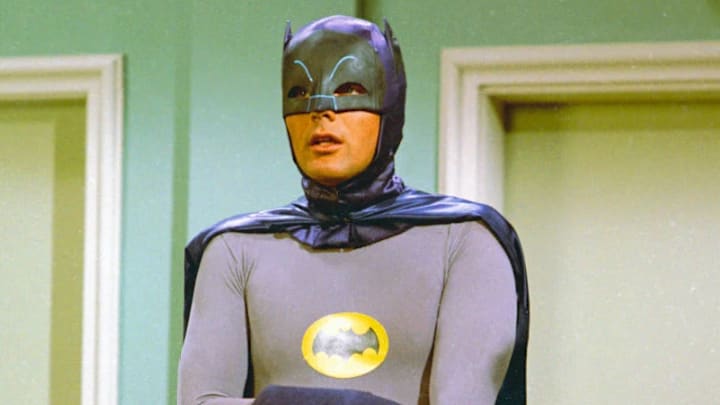
When we all think of the classic 1966 Batman TV series, we all think of Adam West's colorful crime-fighting capers. We all think of the two-part showdowns with the nefarious Gotham City villains, and the light-hearted Bam! Smack! Pow!s of the epic fight scenes. It's what the campy classic series that starred the Caped Crusaders was all about.
What we don't think of, however, are extremely haunting deaths. Why would we? Batman was one of the most entertaining, family-friendly, and silly shows to ever grace TV screens. But way back at the beginning of the show's run in January 1966, there was one unexpectedly haunting death. One that seems quite uncharacteristic of it considering the campy BatMania that came afterwards.
Good Golly, Miss Molly!
Batman premiered on ABC on January 12, 1966, with a 30-minute episode that launched the series' legendary run. "Hi Diddle Riddle" featured the first appearance of Frank Gorshin's Riddler, who sought to take Batman and Robin to court in the hopes of forcing them to unmask for "wrongfully" arresting him. Although it was still very colorful - and very campy - there was a slightly more serious tone than the one that the show would quickly develop (which isn't unheard of in pilot episodes). However, the second installment - the Part 2 of the two-part pilot - is the one that really surprised audiences.
"Smack In The Middle" sees Batman look for Robin, who has been taken by The Riddler. The villain hatches a plan to have his henchwoman, Molly (played by Jill St. John), pose as Robin and make her way back to the Batcave, where she is supposed to shoot Batman. That plan goes to plan... until it doesn't. Batman, being the World's Greatest Detective, figured out what they were up to and neutralized Molly's plan to kill him by destroying the bullets in her gun with a hidden Bat laser beam.
With nowhere left to run, Molly sprints to the top of the Batcave, climbing up what Batman refers to as the Batmobile's nuclear power source. Batman attempts to help her, using a Batarang to guide himself up to the bridge above the atomic reactor. Molly tries to reach for him but, upon revealing that she was too scared, she felt herself slipping and fell into the reactor - immediately perishing.
Given that this was television in the '60s we are talking about here, it wasn't graphic in terms of visuals. But, still, the idea of someone being immediately vaporized by a nuclear power source on a family-friendly comic book series was - and still is - pretty shocking.

Considering Batman's own legacy as a campy relic of the '60s, this moment is uncharacteristically dark for the show - even more so if you watched all three seasons (the third season, in particular, gets quite off-the-wall in the most entertaining of ways). But the truth is that the ABC series initially attempted to match the more Noir tone of the '40s and '50s Batman comics while maintaining some elements of the outlandish, light-hearted stories of the '60s (and adopting their look, too). But, as the show progressed, it found its footing - and it soon became clear that light-hearted camp was exactly what that was.
While the series did feature a number of apparent deaths throughout its run, most of them were early on - again signalling its eventual shift into less serious storytelling. It also never reached this level of disturbing again. Other demises came when Mr. Freeze froze a butler and shattered him into pieces, or when two gangsters ended up shooting themselves when they aimed for Batman. While dark in their own way, as the show fully embraced its more colorful tone, it began to dial back on the seriousness of it. There were fakeout-deaths too (with Catwoman's apparent fall down into a bottomless pit and the Dynamic Duo's demise after a faux showdown with the GCPD) but those were ultimately undone. And, as a result of that, Molly's death in the second ever episode of Batman remains the only time that a named, main character perishes on-screen.
To quote Batman: "What a terrible way to go-go."
 Add us as a preferred source on Google