

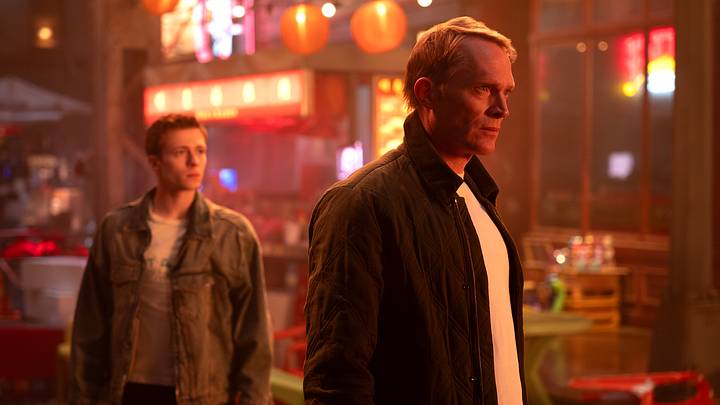
Paul Bettany is one of the original Marvel Cinematic Universe cast members, voicing Jarvis in the first franchise film, Iron Man. He was transmuted into Vision during Avengers: Age of Ultron, where Bettany upgraded for a live physical performance. After meeting his demise in Avengers: Infinity War, he was re-purposed for WandaVision, co-starring with Elizabeth Olsen’s Scarlet Witch. Now Bettany’s Vision earns a singular top billing in Disney Plus' VisionQuest.
VisionQuest is a trilogy capper
What may go down as one of the best television trilogies of all time, VisionQuest is the third show in the WandaVision sub-series. Of course, none of the events that occur in this limited series would be possible without WandaVision. In that show (the first Marvel Studios Disney Plus production), Wanda crafted her own “perfect” world where Vision was still alive and they had two sons. Two streets in their Westview town were Sherwood and Ellis, which is how Vision comes up with the alias “Sherwood Ellis” in VisionQuest.
Elsewhere, SWORD kept Vision’s initial demobilized body and reactivated it using Wanda’s own energy source, since the Mind Stone was no longer available to power him up. It was in a battle between the two Visions where Wanda’s Hex Vision transferred his “mind” into his old body, which is now a White Vision. With everything in the Hex destroyed, this White Vision is the version that is operational in VisionQuest.
Fun nods to WandaVision include Ultron’s screen displaying a “Sorry we are experiencing technical difficulties” message, similar to “Please stand by” that was often shown in the first series. Perhaps the greatest tribute that VisionQuest pays the show that started it all is its own sitcom-inspired simulation. This takes place near the show’s conclusion to truly weave the saga into a full circle. This time it is Vision who confines Ultron into a television reality.
The centerpiece of the trilogy is Agatha All Along. In that middle series, it is explained that as Billy/Wiccan was going to disappear in conjunction with his mother’s reality-warped world, he magically transmitted his soul into a dying boy. Then, near the end of that tale, Billy again used his sorcery to find a dying body for Tommy/Speed’s disembodied consciousness to occupy.
Wiccan and Speed reunite in the VisionQuest finale. The former is also spotted whispering to Ghost Agatha (although she is not visible to the audience). It was always a strong possibility for Joe Locke’s Billy to reprise his Agatha role in VisionQuest, and it is certainly rewarding to have him come through in the 11th hour.

The many components of Vision
It has been cited in the past that Vision was constructed from an amalgamation of many different AI fragments. All of them were in one form or another conceived by Tony Stark. In VisionQuest these are “personified” in Vision’s mind as consisting of Vision, J.A.R.V.I.S., F.R.I.D.A.Y., E.D.I.T.H., Ultron, D.U.M.-E., and U.
Jarvis is again played by James D'Arcy; Marvel enthusiasts likely recall that D'Arcy played the human caretaker Edwin Jarvis in the MCU-adjacent show Agent Carter. He was the first actor to make the jump from a non-Disney Plus project to a full-blown MCU film when he cameod in Avengers: Endgame. Tony Stark revered Jarvis so much that he named his primary AI after him.
Friday is Stark’s Jarvis replacement after his AI becomes the foundation for Vision. Friday was the voice of Stark’s suit for every post-Jarvis instance, starting with Avengers: Age of Ultron. It would have been delightful if Oscar nominee Kerry Condon could have converted her voice part into a physical representation, a la Paul Bettany’s Vision, yet here Friday is portrayed by a different Irish actress, Orla Brady.
Friday discloses that Tony Stark designed her based on Howard Stark’s “gal Friday” Alison Hogan. The last name Hogan implies that Alison was Happy Hogan’s mother, or at least a close relative of Tony’s good friend.
Edith, unlike Jarvis and Friday, was not a prime Iron Man AI, although she did have access to Stark’s entire satellite network. Edith was exclusively linked to a pair of sunglasses that were gifted to Peter Parker in Spider-Man: Far From Home, after Tony’s passing. Edith quips that she once had a boss who was in high school. While Dawn Michelle King voiced Edith in that solo Spidey flick, she is brought to life by Emily Hampshire in VisionQuest.
James Spader magnificently reprises Ultron in VisionQuest. He initially used motion capture for the robotic AI in Avengers: Age of Ultron; however, he is ordered to look humanoid in Vision’s mind palace. Ultron was programmed by Stark and Banner before going rogue and threatening Earth’s extinction. Vision defeated Ultron in the Avengers epic but (perhaps unwisely) allowed some semblance of the AI to live on.
DUM-E and U were hydraulic arms that Stark utilized in his workshop. Like Paul Bettany’s Jarvis, they date back to the first MCU movie, Iron Man. Since they were robotic tools, their human avatars speak much less often than the other AIs in the mindscape. They are mainly tasked with handywork and odd jobs in Vision’s simulation.
Other MCU connections
Vision works in a pub in Edinburgh, the same city where he and Wanda lived a quiet, happy life together, until they were attacked by Thanos’ Black Order in Avengers: Infinity War. Vision often thinks of the woman he loved and is aware of Wanda’s death—he even confirms that she was crushed under a mountain, which is how she sacrificed herself in Doctor Strange in the Multiverse of Madness.
Just like Vision was willing to die for his companions, in Infinity War, Jarvis sacrifices himself in this show. The grief of losing Jarvis reminds others of Tony Stark’s death in Avengers: Endgame, confirming their bond to their previous engineer. DUM-E and U also have a callback to the first Iron Man when they similarly use fire extinguishers to comic effect.
Early on when threats begin re-emerging, Jarvis suggests that Vision reach out to Hulk or Hawkeye for help. Later, when Vision’s body is severely damaged, Banner is again brought up as someone who may have the expertise to fix him. Vision says that Banner is not available, which may hint that he is aware of the trouble that Hulk recently “caused” in New York during the plot of Spider-Man: Brand New Day.
One VisionQuest chapter takes place on Remembrance Day, which is the anniversary of the Battle of Sokovia, the day the Avengers prevented Ultron from wiping humankind off the Earth while still causing massive casualties in Wanda’s home country. Aside from Ultron returning as a significant threat, a more street-level operative is a surprisingly effective adversary against Vision.
The bounty hunter Paladin operates out of Madripoor. This seedy city is featured in an episode of The Falcon and the Winter Soldier; a place where criminals and other dregs of society thrive. This is the only MCU media to return to Madripoor since that 2021 series, and once there, our heroes run into one of the first MCU miscreants, Raza. He is the Ten Rings affiliate who kidnaps Stark in Iron Man. The 18-year gap in appearances for Faran Tahir is a new MCU record.
It was Raza who supplied Paladin with adamantium bullets in order to pierce Vision’s vibranium skin. Adamantium is the indestructible metal famously infused inside of Wolverine, but the resource has a particular origin in the MCU. In Captain America: Brave New World, it was explained that adamantium was discovered on Celestial Island, which is the petrified Celestial stuck in the Indian Ocean from the movie Eternals.
Vision learns that Paladin was a victim of Thanos’ snap. Other than those missing years, Paladin has a long history as a hired gun and specifies three anti-heroes that he has crossed paths with. He says he was bitten by a “reasonable guy by day”, which is obviously Jack Russell a.k.a. Werewolf by Night. He has a “punishing disagreement” in Brooklyn, alluding to a clash with Punisher. And he also mentions getting hit with a billy club in Hells Kitchen – clearly talking about Daredevil. Paladin was a comic book foe of the latter two.
The sixth episode contains yet another Watcher Easter egg. Uatu’s reflection can be seen in a glass doorway in Madripoor. The Watcher is voiced by Jeffrey Wright in the animated series What If…? and has cameos in other series such as I am Groot, Marvel Zombies, Eyes of Wakanda, and Your Friendly Neighborhood Spider-Man. His most significant live-action sighting came earlier this year in Daredevil: Born Again season 2.
A weapon that audiences may have not expected to see in the MCU again returns in the seventh episode. Paladin has secured Corvus Glaive’s spear, which has enough cosmic energy to restore Vision’s source code. This weapon is directly linked to Vision, since Glaive stabbed him with it in Infinity War, before Vision ultimately returns the favor and kills Thanos’ general with the spear. Paladin must have gone through great lengths to smuggle it out of Wakanda.
Jocasta is unveiled as a major antagonist in the story—a synthezoid with the mind of a deceased scientist, Jo Carrington. Is it a coincidence that Carrington died in 2008? That is the same year that Iron Man was set, and VisionQuest confirms that her work with AI was bought by Stark Industries. Carrington even won a Stark Award for her AI accomplishments, which likely led to his offer for her technology.
Although he is teased earlier in the season, Jim Hammond comes to fruition in the penultimate act. Jim was created by Phineas Horton (both played by Paul Bettany) in the late 1930’s as the first android/Artificial Intelligence/Synthetic Man. In comic lore, he was the original Human Torch. In the MCU, he was showcased at the Stark Expo in Captain America: The First Avenger, in the 1940’s.
If having a 15-year-old MCU Easter Egg pay off wasn’t rewarding enough, the most monumental franchise connection in VisionQuest occurs in a post-credit scene. The mountain that crushed Scarlet Witch is lifted off of her by none other than Doctor Doom. He somehow saves or resurrects her in order to claim her "power."
This is the second Avenger that Doctor Doom has recruited (or taken by force). One of the new Avengers Endgame: Encore credit scenes presented him coming for Hulk while the Avenger was still processing his mind-controlled encounter in Brand New Day. Now both Hulk and Scarlet Witch are guaranteed to be involved in the forthcoming Doom narrative, whether in Avengers: Doomsday or Avengers: Secret Wars.
 Add us as a preferred source on Google