

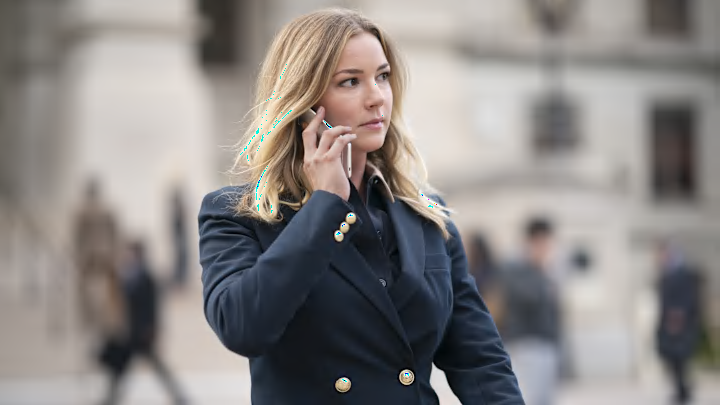
“The Carter name has always been synonymous with service and trust.” That line from The Falcon and the Winter Soldier refers to all the work Peggy Carter had done during World War II, with the S.S.R., and as a leader in S.H.I.E.L.D. But it also refers to Sharon Carter, who worked as a S.H.I.E.L.D. (and later CIA) agent to help the world and protect people. That legacy may have begun with Peggy, but it continues because of Sharon. Or at least it did when Marvel cared enough about Sharon’s story.
As the Multiverse Saga has progressed, Marvel has struggled to develop certain characters properly and follow through with particular narratives. Shang-Chi had a successful movie but hasn’t been seen since. Sam Wilson didn’t get his Captain America movie until four years after formally accepting the mantle. Hawkeye was well-received but didn’t get another season, and Hailee Steinfeld’s Kate Bishop has gotten only a cameo since then.
The same has happened with Sharon, disappearing from the overarching narrative despite an intriguing open-ended storyline in The Falcon and the Winter Soldier.
Sharon’s initial role in the MCU was to be this potential love interest for Steve Rogers. Once Marvel opted against following through with that, it decided to stray from the comics counterpart. This opened the doors for what Sharon could be and do in the MCU. So not following up has been a waste of her character and narrative. And it’s even more of a disappointment considering the various opportunities where Sharon could have easily fit into other projects.

From Agent 13 to the Power Broker
When Emily VanCamp’s Sharon Carter made her MCU debut in Captain America: The Winter Soldier, the full context of her character was still unknown. Initially, she was an undercover S.H.I.E.L.D. agent assigned by Nick Fury to watch Steve Rogers, living in an apartment down the hall from him and pretending to be a nurse. Eventually, she’s revealed to be a S.H.I.E.L.D. agent using the codename Agent 13.
During the rest of the film, Sharon may not have had Steve’s complete trust because of her deception, but she proves to be one of the good agents in S.H.I.E.L.D. She isn’t quick to obey orders to go against Captain America. She questions S.H.I.E.L.D. authority, knowing such a demand deserves a proper explanation. She is against Hydra and wants to stop her traitorous colleagues from taking over and poisoning more of society with the organization’s fascist agenda.
It isn’t until Captain America: Civil War that her full identity is revealed: when she explains, at Peggy Carter’s funeral, that Peggy was her great-aunt. That background information gives further context for the kind of person Sharon is, not just relationally but characteristically. Sharon was obviously influenced by her great-aunt.
She joins the agency her relative helped found, and she has a similar dedication to fighting for what’s right. She even has no problem going against the law to help Steve in Captain America: Civil War. While Steve being the one who needs help plays a factor, Sharon doesn’t solely help just because it’s him. She helps him because she understands what he’s fighting for.
Even if it’s a lot to live up to, Sharon tries to be an extension of her great-aunt’s legacy. But that didn’t matter once the Sokovia Accords came into play, and that’s essentially what led her to become a crime lord in Madripoor. It could’ve been interesting to see how Marvel would further develop Sharon as a legacy agent, but it could’ve been even more compelling to see how else that legacy shaped her even as the Power Broker. Because Sharon doesn’t just decide to become a crime lord. Just like her great-aunt, she’s strong. She’s a fighter. She resorts to crime, harnessing power and gaining influence, to survive. Peggy’s influence is there even if Sharon isn’t doing good.

How Sharon Carter could’ve been used in MCU projects after The Falcon and the Winter Soldier
When Sharon was revealed to be the Power Broker in The Falcon and the Winter Soldier, it was a stark contrast from what her character had been like before. Sure, it was valid for her to be upset about the treatment she received after Captain America: Civil War because of the Sokovia Accords. But choosing to be a double agent after the American government pardons her and offers her a job proved just how different she had become.
These differences could have been explained by making her a Skrull, leading to a Secret Invasion tie-in. One of the issues with that show was that the invasion didn’t feel impactful enough or like a global threat. But expanding the scope of the invasion to include more characters, like Sharon, as Skrulls could have helped.

Besides the Skrull route, Sharon could have been used in a way she is known for: as a staple Captain America character. She was already set up to keep her status as a mainstay Captain America character by being in The Falcon and the Winter Soldier. Her open ending in the show could have carried over to Captain America: Brave New World. She would’ve been a natural choice to continue being an ally to Captain America. Sharon had already supported Sam as the next Captain America. It could have been riveting to see him discover and deal with Sharon’s deceit.
Being the Power Broker made it clear that Sharon had been engaging in nefarious practices in Madripoor. But had Sharon become a full-on villain, or was she just being villainous? She may have just veered into antihero territory, which would have made her a perfect addition to Thunderbolts*. In Marvel Comics’s most recent iteration of the Thunderbolts, Sharon is a featured member of the team led by Bucky Barnes. As of late, the comics cater more to the movies and shows, trying to achieve MCU synergy instead of being their own standalone narratives. So having Sharon be part of the antihero team could have made sense from both sides.
This isn’t to say Sharon should have been a member of the MCU Thunderbolts team. Every member has some sort of enhanced abilities, so it wouldn’t have necessarily made sense to include Sharon on the team without giving her some sort of powers. But it could have made sense to have her in a behind-the-scenes, sideline role like Valentina Allegra de Fontaine. Maybe the two could have even teamed up. After all, Valentina is the director of the CIA, and Sharon was offered a position within the agency after being pardoned. That duo could have offered a lot of potential and heightened the complexity of the conflict.
With Avengers: Doomsday looming and a presumed shift in the MCU after Avengers: Secret Wars, it feels like there might not be time to continue Sharon’s story in the way she deserves—if at all. Maybe Marvel should consider its own words: if the Carter name has been synonymous with service and trust within the actual MCU, then trust that Sharon Carter can serve the MCU.
 Add us as a preferred source on Google