

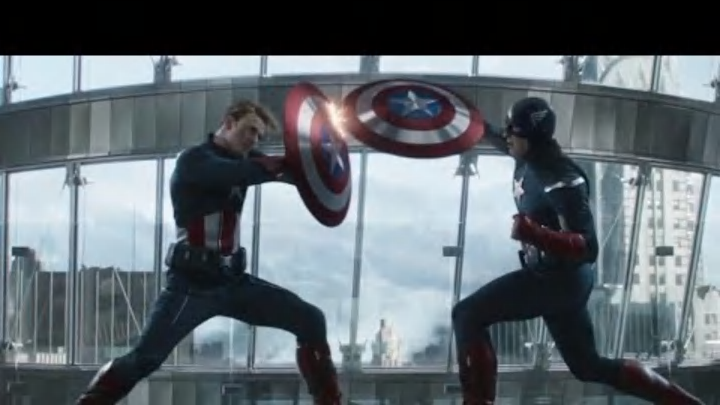
Bear with me, because I know this is a lot of real-world depth being attributed to a comic book character turned movie icon. I’ve been thinking about Captain America and what he represents.
From Autumn 2001 to sometime between 2003 and 2005, a core memory bore itself deep in my psyche. A sentiment, rising like an eagle taking wing; the American flag draped everywhere: businesses, churches, schools, pretty much any building you can think of. Alongside it came a hope, purpose, a grand swell of unity.
Of course, this wouldn’t last long. Politics being politics, people are prone to gnash at each other like rabid dire wolves. And that unity didn’t bring about anything positive or substantial. For every “Courtesy of the Red, White, and Blue” by Toby Keith, there was an “American Idiot” by Green Day.
Today’s division in politics can be attributed to many, many things. This rage, fear, and anxiety rampant, robed in red, white, and blue, is but one microcosm of this greater beast.
And who do we turn to when we are afraid of beasts? We look to whatever light we can. Music that soothes our own inner monsters, sports to remind us of fighting spirit, and fiction to let us know we are not alone in someone else’s dreams made manifest.
In that, I learned something from someone with wings on his head and a shield on his arm. Captain America.
The Rorschach Test of Captain America
I’m speaking strictly about the Steve Rogers iteration of Cap here. His perception can be shaped in any era, depending on the creative team and the environment that depicts him. Current events, when examined through fictional lenses, are a psychological extension of the mind behind the art.
Typically, he’s depicted as standing up for what he believes is right. Rogers, as Cap, doesn’t like bullying. In the past, he’s opposed the government itself, as seen in the original, 1970s “Secret Empire” storyline and the “Civil War” storyline, inspired by the Watergate Scandal and the Bush Administration, respectively. In the MCU, he’s gone rogue for the same reason in Captain America: The Winter Soldier, which was derived from Edward Snowden's whistleblowing of the mid-2010s. Even in the MCU’s adaptation of Civil War, Rogers challenged the demands of the Sokovia Accords that forced heroes to adhere to guidelines. Having dealt with a faulty U.S. government before, it’s not hard to see why.
Granted, when it mattered most to mutantkind, Rogers hasn’t always remained steadfast in his stances on liberty. In numerous X-Men stories, he’s operated as a government stooge, a boy scout. There’s been an evolution in this relationship, though. One that saw Rogers’s further disillusionment with the American government grow parallel to the X-Men’s quest for equality. Sure, there were bumps in the road, seen in Secret Wars (1984-85) and Avengers vs X-Men (2012). That involves far more context than needed, but there’s a lot of nuance that fleshes out the Marvel Universe and how Steve’s world operates beyond his role as protagonist.
For instance, Marvel’s original Ultimate Universe had a Captain America that followed conservative ideals. Jingoistic and nationalist, he opposed political correctness. I’m overselling it a bit, but overall, he followed the state rather than the idea that comes with the American Dream.
Back in the main Marvel Universe (Earth-616) and the MCU, Rogers would abandon the moniker of Captain America completely, temporarily becoming Nomad and Steve Rogers in these respective depictions. Frustrated with the direction of America following the Watergate Scandal and the moral murkiness of the Vietnam War, he didn’t want to represent the United States if it aligned with the public perception of him in tandem with the government.
Fittingly enough, with this article, even Rogers was confused about what the mantle of Captain America truly means. He, too, struggled with his discernment of American patriotism.
Historical Perceptions of Captain America
Most superheroes have a quote attributed to them. Superman has “Truth, Justice, and the American Way,” which has since changed its ending to “and a better tomorrow” and “and the human way.” Uncle Ben’s words echo through Spider-Man with his motto: “With Great Power Comes Great Responsibility.” The Dark Knight himself instilled confidence about his quest for vengeance with “I am vengeance, I am the night, I am Batman.”
Fans familiar with Captain America will immediately notice a different one. It’s a beautiful sentiment that embedded itself in my mind when I first read it.
“Doesn’t matter what the press says. Doesn’t matter what the politicians or the mobs say. Doesn’t matter if the whole country decides that something wrong is something right. This nation was founded on one principle above all else: the requirement that we stand up for what we believe, no matter the odds or the consequences. When the mob and the press and the whole world tell you to move, your job is to plant yourself like a tree beside the river of truth, and tell the whole world, ’No, you move.’”
This quote by Rogers was featured in The Amazing Spider-Man, No. 537, during an inspirational speech to the wall-crawler, and in the film Captain America: Civil War, this time recited by Sharon Carter at Peggy Carter’s funeral. And it’s not the first time these words were spoken; the quote itself derives from Mark Twain, specifically his book, The Bible According to Mark Twain. Going back further, the Missouri author’s “tree beside the river of truth” hearkens to a passage in the Bible, Revelation 22:1-5.
Despite Cap’s uplifting words, he found that this line of thinking can be dangerous if one isn’t cognizant of when one is eventually proven wrong. For instance, the comic book run of Civil War revealed that the plot wasn’t of superheroes fighting for what they believed to be right, but rather how ideological extremism further separates everyone, drives them further when no middle ground can be reached, and the dangers thereof.
Words and ideas are immortal. They last beyond us, ghosts of what we leave behind. Cap’s “no, you move” quote is emblematic of this. Anyone can look at their worldview, believe it is right and just for everyone, despite evidence that it restricts others. For everyone who sees themselves as Captain America, there will be people analogous to his prior relationship with the X-Men.
Yes, we should absolutely be firm in our ideals, stand up to oppression, and love our neighbors. That is true. But we should also prepare to look inward, indulge self-consciousness, and see how our thoughts and beliefs shape not just the perceptions we garner, but the lives of people we affect. Don’t budge against bigotry, don’t cozy up to it, but understand when and where bridges must be built.
What Captain America means
Captain America No. 322, published in Autumn 1986, featured a story where the star-spangled protagonist faced a terrorist group attempting to slaughter hostages in a monastery nestled within the Swiss Alps. This bears little to do with the topic, but what was said in the issue when I first read it spoke to me.
As he fights this ULTIMATUM group to liberate their captives, Rogers has an inner monologue reflecting who he is. Rejecting the representation of the American government, the political system therein, and the policies, he reminds himself that he is the American Dream, that human beings should be entitled to better lives and reach their dreams. The role of Captain America is an extension of that dream. Admitting he’s not perfect, he tries his best; he even goes so far as to say he’d defend anti-nationalistic notions, like ULTIMATUM was doing, albeit only if they were not acting in violent extremism in the same way.
This is the core of Captain America. He may align with whatever the hot-button topics require him to, adapting to the times as any normal being should, but he has a code to oppose “bullies”, bullies such as terrorists, extremism, and violence. It’s inherent to who he is, a man who longs for diplomacy in place of war. Poetic, considering he’s fought in wars.
Having him vulnerable enough to realize how idealistic and flawed this is, and his desire to stand up for his beliefs even when the world tells him no, adds a nice wrinkle to his character. That example from Civil War, when he tearfully observes violence replacing the democracy he so advocated for, is key to all of this.
Captain America represents the American Dream, as flawed as it is, as hard as it is to maintain. It’s hard work, but it’s what he signed up for. Of course, it’s not going to be perfect. It’s human. He’s human.
And naturally, that will shift in time. Through this, all of humanity’s principles will slide and fall and morph. He grows, for better and for worse, and what we see of him may or may not reflect all fans, but it speaks to our raw impulses.
Conclusion: Politics in Comics
When it comes to comics, Captain America is but a mascot for what needs to be said; whatever is burning in the creative team’s soul, should they find the place to say it. The same applies to Superman in his quest for empathy as an immigrant. It applies to Batman and his gothic battle against crime and mental health. Even the X-Men’s war to absolve mutantkind’s victimhood in the face of identity politics and Spider-Man’s urge to choose morals over economic prosperity. If we wanted to go further, The Hulk is analogous to the depths people would go to for warfare, and politics have also shaped Wonder Woman’s feminist stance.
All things political can be found in fiction. Dig deep enough, and there might be a small ember of it in Bluey or Days of Our Lives. Art is filled to the brim with the circumstances that birthed it. In a world bereft of the ideals instilled in us, art gives us that which we should aspire to. It’s in our nature to hope, no matter how nihilistic we might be.
I feel Captain America is often overlooked for how someone like him would be entrenched in the world of politics, despite his disdain for such. Understandable, since politics is a murky carnival show, not a civil mission to take care of a place’s citizens.
Ending full circle, that post-9/11 world I witnessed is no longer the one I feel in line with. To me, patriotism isn’t about the red-striped flags and the white stars in a sea of blue. It’s not in the Pledge of Allegiance or the Star-Spangled Anthem. It’s in the communities. The firefighters who douse flaming houses, the baristas who make your coffee, and the janitors who clean the hallways. It’s in ordinary, real-life citizens and fictional heroes like Captain America.
In times like these, our neighbors are at each other’s throats, relying on defense mechanisms and rightfully so. But someday, if everyone plants themselves like a tree by the river of truth, society can make the world move.
To quote Spider-Man’s Aunt May: “There's a hero in all of us.”
 Add us as a preferred source on Google