

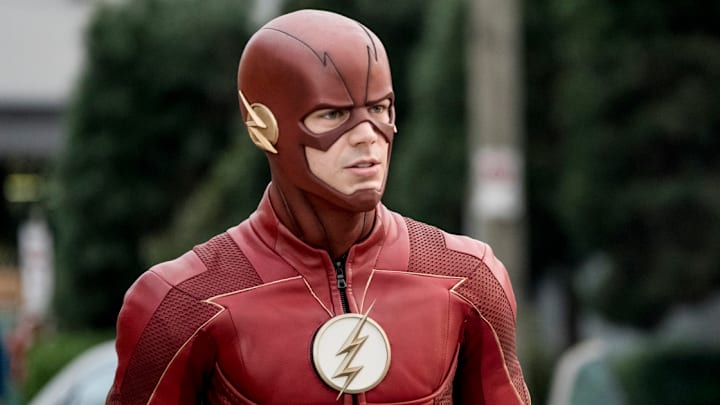
It's hard to remember a time before The Flash existed. Widely regarded as one of the most pivotal TV shows of the 2010s, it helped spear-head the return of superheroes to the small screen, carrying on a legacy set forth by is parent series Arrow just a few years beforehand. And when it premiered on The CW in 2014, it did so much more than just expand the Arrowverse; it single-handedly changed the game for the genre, offering up a small screen DC Universe featuring one of the most well-known superheroes at its heart.
Starring Grant Gustin as the Scarlet Speedster, The Flash showcased the weekly adventures of Barry Allen as he developed super-powers, aiming to use them to solve his own mother's murder. However, he quickly found himself becoming the history that Central City needed as he repatedly protected it from a strong of other metahumans who sought to do it harm. At the very top of that list was his archenemy: The Reverse-Flash.
It goes without saying that The Flash had an incredible run, breaking viewing figures records for The CW in the US while also becoming one of the biggest TV shows in the world. It's no surprise that it ended up running for nine seasons. However, it's important to point out that not all of those seasons were success stories in an of themselves, as fans widely consider a number of them major missteps.
With that in mind, let's dive back into the STAR Labs archives and rank each season of The Flash from Time Sickness lows to Speed Force triumph.

9. The Flash Season 9
- The Good: Green Arrow's return. Episode 9 and 10 are phenomenal. Batwoman cameo.
- The Bad: A season of filler episodes. Corny dialogue. Too much reliance on Cecile, Chester and Allegra. Caitlin's "death" and Khione. Too many short stories are void of stakes. Lacklustre finale.
You see that image of The Flash, Green Arrow, Kid Flash, and Spartan above? That is one of the very few glimmers of brilliance that The Flash‘s ninth and final season contained. It was a rare moment that reminded all of us of how incredible this show once was and made us all nostalgic like a final season is supposed to. Unfortunately, the same can’t be said for the rest of the season.
Even with a fantastic season opener and a promisingly great villain in the Red Death, the show’s “graphic novel” format had run its course at this point. Batwoman‘s Javicia Leslie was delightfully campy as the Red Death but the storyline amounted to nothing after five episodes, and was then immediately followed by an “interlude” which featured nothing but filler episodes. This left the show with just four episodes to tell its final ever storyline.
A final season is supposed to be all about looking back, but The Flash‘s was stuck in the present, operating like any old season. Secondary characters were given far too much screentime, Caitlin was disrespectfully “killed off” without a mourning period so that lookalike Khione could be rushed into the equation, and the show’s primary characters were lost in the midst of all of this. To make matters worse, Khione’s arc never amounted to anything; she was there and then she wasn’t. It was all so pointless. And speaking of amounting to nothing, the series finale – while solid on paper – lacked the emotional resolution that it should have had, with it all feeling very rushed, underplanned, and just like the ending of any old “graphic novel” arc.
The Flash has been worse than it was in season 9 (see our next entry), but those mistakes were forgivable as the show figured itself out post-Crisis. What isn’t forgivable is knowing what those mistakes are and continuing to make them in a shortened final season when the focus should have been on wrapping up this wonderful show on the high note that it deserved.
The fans were ready to love season 9, but this just wasn’t what it should have been.

8. The Flash season 7
- The Good: The Flash Family. Jay Garrick's return. Impulse's debut.
- The Bad: The Forces storyline. Poor execution of the Godspeed storyline. The "graphic novels" format had gone stale. "Team Flash". Corny dialogue. Barry losing his speed (again). The infamous lightsaber battle.
Fresh off a return to form in a brilliant sixth season, The Flash looked to continue its resurgence. Unfortunately, it wasn’t to be in season 7.
Not only was it tasked with wrapping up season 6 (which had been cut short due to the pandemic), it had to focus on its two primary storylines – or “graphic novels” as showrunner Eric Wallace likes to call them – as well as an unnecessarily long three-episode interval. Episode count has been an issue for The Flash in the past but that’s usually down to it having too many episodes. Season 7, however, had too much going on and not enough episodes to spotlight any of it.
The Forces of Nature arc was an exciting one on paper, but the execution of it left a lot to be desired, as we eventually got adult human versions of the Speed, Still, Strength and Sage Forces calling Barry and Iris “Mom and Dad” (even though one of them looked like Barry’s mother) and their constantly shifting allegiances made it hard to take any of them seriously. And even though the subsequent Godspeed arc was handled much better, the four-episode saga failed to live up to its year-long build, ending before it really got a chance to showcase the stakes it should have had.
It’s also hard to overlook the fact that the show lost two original cast members this season in Carlos Valdes and Tom Cavanagh. To its credit, it certainly tried kick off a new chapter for Team Flash but both Cisco Ramon and Harrison Wells were so integral to the show that their absences were inevitably going to be felt. And they certainly were.

7. The Flash season 4
- The Good: A break from speedster villains. More light-hearted and fun. Neil Sandilands' performance. "Enter Flashtime"
- The Bad: The Thinker is too powerful. Often gets too corny. Some lacklustre episodes.
Hoping to leave its days as a speedster-only show in the past, The Flash attempted to introduce a new type of big bad in season 4. Unfortunately, that brought with it a whole new list of problems that made the speedster fatigue look much better in hindsight.
While Clifford “The Thinker” DeVoe was played remarkably by Neil Sandilands, the story did not serve the character well. Or maybe it served him too well, as he eventually became far too powerful for Team Flash to overcome, resulting in a pretty hopeless season with too many episodes that saw our heroes defeated by the villain over and over again.
To make matters worse, DeVoe’s plan relied on a group of new metahumans, meaning that we got a heap of villain-of-the-week episodes that lacked the heart of the show’s previous ones and almost always ended in a death.
There’s an irony in the fact that this season’s shining light is an episode centred around speedsters, as “Enter Flashtime” stands above everything else season 4 did and remains one of the all-time greatest episodes that The Flash has ever produced. And that alone makes this season worth watching.

6. The Flash season 8
- The Good: The "Armageddon event". A few runs of decent episodes. Great acting.
- The Bad: Time Sickness. Joe West's sidelining. Too much focus on Chester, Allegra, and Cecile.
The Flash season 8 is a strange beast. On one hand, it produced some incredible episodes that genuinely felt like they belonged in the show’s golden years, but the problem lay in the fact that most of them only functioned when taken out of context. The reason being that the season’s central narrative made it hard to buy any of the characters’ behavior, simply because they should have been worried about Iris West-Allen.
Iris’ Time Sickness was one of the few things carried over from the previous season but it quickly became clear that it should have stayed there. No matter what the writers did with it, it never carried the stakes that it should have. It felt like an underdeveloped afterthought in an overstuffed season and that season actually got better whenever it steered clear from that storyline.
It goes without saying that Iris deserved better than that, particularly because her four-episode absence resulted in a streak of solid episodes that never felt quite right because her family was totally fine with the fact that she was trapped in the Still Force.
That aside, there was a lot to love in there, particularly the five-episode “Armageddon” event that opened the season as it introduced Despero, brought back a lot of familiar faces from the Arrowverse and finally gave Barry Allen the comic-accurate gold boots we had all been waiting for.

5. The Flash season 5
- The Good: Introduction of Nora West-Allen. Grant Gustin and Candice Patton's performances. Killer Frost. Exceptional season finale.
- The Bad: Cicada was a poor, repetitive villain. Too many episodes.
The Flash‘s connections to the future grew exponentially in the show’s fifth season and it all had to do with the arrival of Barry and Iris’ daughter Nora West-Allen. Portrayed by Jessica Parker Kennedy, the quirky and lovable speedster had sporadically popped up in season 4 before we actually knew who she was, and now it was up to season 5 to tell us everything.
For the most part it succeeded, successfully integrating Nora into the show and giving the DC fans some neat futuristic Easter Eggs along the way. The struggle came from the season’s tendency to go around in circles, with Nora continually making the same mistakes in spite of the show’s effort to make it clear that she had learned from them. Thankfully, Jessica Parker Kennedy’s joyous performance elevated the story past its issues, and there were some genuinely jaw-dropping twists in Nora’s journey.
Season 5’s biggest issue was its villain, Cicada. A meta-murderer intent on seeking vengeance for what happened to his niece, the potential was there, but it was never realized. The character came off as one-dimensional and allowed the season to give in to its repetitive nature, as Mr. “This Ends Now” would show up, almost kill Team Flash, get outsmarted, and inevitably escape. And our beloved team of superheroes (including Killer Frost, who was immune to his meta-dampening dagger) kept watching it happen on a cycle. No Cicada, it did not “end now”. Not even close.

4. The Flash season 6
- The Good: The first half of the season. Crisis On Infinite Earths. Grant Gustin's performance. Bloodwork was a great villain.
- The Bad: Poor, dull second half. Corny dialogue. Lacklustre ending.
After too many seasons of too many episodes, the creative team decided to use The Flash‘s episode count to their advantage, opting to do two mini-seasons within one. Enter Eric Wallace’s “graphic novel” approach.
The first of those graphic novels saw the introduction of Bloodwork, a villain more horrifying than The Flash was used to, offering up seven episodes of pure intensity, all while successfully setting the stage for the Crisis On Infinite Earths crossover that the show had been building to since it debuted. The second of the arcs was less successful, but it did see the show finally adapt the iconic Mirror Master in Eva McCulloch’s Mirror Monarch, and it centered around a story that allowed Barry and Iris West-Allen to be at the heart of it.
The graphic novel approach was a bold change, but it was one that benefited the show a great deal simply because it reduced the chances of a story getting too dragged out, cutting down on repetitive plots and avoiding glaring plotholes like we saw with Cicada in the previous season. It also allowed the show to give Crisis the focus it needed as it was neatly positioned between the season’s two major storylines.
All in all, season 6 was a major comeback for a show that had been struggling for sometime, and it reinvigorated it a great deal. It’s just a shame it was cut short before the story could finish.

3. The Flash season 3
The Good: Savitar. Grant Gustin's performance. High stakes. H.R. Wells. Great stroytelling. Incredible season finale.
The Bad: Another speedster villain. Julian Albert's confusing story.
The third season of The Flash decided to up the ante in a huge way in a bid to become the show’s most larger-than-life offering. Off the back of two evil speedster villains, the series introduced Savitar, the God of Speed, who took a great deal of pleasure in torturing Barry Allen with the promise of killing Iris in the future.
The stakes were certainly present in season 3, as were a number of intriguing new characters, such as Dr. Alchemy, Julian Albert (played by Harry Potter’s Tom Felton) and Earth-19’s Harrison Wells H.R. Unfortunately, it did fall a little short because of the fact that we had another evil speedster on our hands – one so powerful it forced the writers to bend over backwards to make him a more formidable threat than the previous ones, resulting in a time-travel story way too convoluted for its own good.
It also shoehorned Iris into a story that left her with little outside of damsel-in-distress, never really made the most of Felton’s character and spent far too long on its “Future Flash” story that fans ended up figuring out the twist before it played out.
The Flash season 3 certainly had its issues but all in all it still felt inherently like The Flash – something that some of the later seasons failed to do. There were plenty of highs in there too, particularly its musical episode (a crossover with Supergirl) that gave us one of the finest hours in the show’s eight-year history, and the season, as a whole, is much more enjoyable on rewatch.

2. The Flash season 2
- The Good: Zoom. Birth of the Multiverse. Earth-2 two-parter. Harry Wells. The performances. Great season finale.
- The Bad: Occasionally derivative of season 1.
Fresh off a stellar first season, The Flash went back to the drawing board in a bid to recreate that success for season 2. The show accomplished that by taking a lot of what worked in the first season and repurposing it to match the new storyline. One evil speedster was swapped out for another and, instead of revolving around time travel, we had the multiverse as the season’s central focus.
Season 2 is all about fallout, as Barry and the team struggle with the aftermath of the Reverse-Flash’s reign of terror, but any hopes they have of rebuilding all goes to hell when a new, deadlier speedster surfaces. An arrival from Earth-2, Zoom is nothing short of horrifying and serves as another formidable foe for Central City’s savior. And speaking of Earth-2, it’s hard to imagine where the Arrowverse would be without this season, as it not only introduced us to the multiverse, it bridged the gap between The Flash and Supergirl, making it season 2 that much more pivotal in hindsight.
There are a lot of familiarities, and it’s not quite as successful as the first season, but The Flash season 2 was a worthy sophomore outing and another check in the win column for the flourishing Scarlet Speedster.

1. The Flash season 1
The Good: Exceptional debut season. Grant Gustin's performance. Tom Cavanagh's performance and The Man In The Yellow Suit arc. Arrow crossover. Villain-of-the-week episodes. Exceptional season finale.
The Bad: N/A
How do you launch a successful show in an already successful universe in the hopes of finding even greater success? Watch The Flash season 1 and you just might find the answer.
Focusing on Central City CSI Barry Allen, who had previously appeared in two episodes of Arrow, the show brought the origins of DC Comics’ iconic Scarlet Speedster to the small screen. But it did more than just that, it enhanced the world that Arrow had already established, opening it up to a new one full of metahumans and super-powers, and at the center of all of that was The Flash.
Barry’s journey to becoming Central City’s savior was about more than powers, though, it was about heart, as the lovable young man was a hero long before he was granted abilities by the Particle Accelerator explosion. And his desire to find out who killed his mother and framed his father drove the show forward, grounding a super-powered series with enough realism and heart that it was impossible to do anything but root for him. And when you really think about it, that’s what The Flash was all about: Heart.
There is so much that the show got right that it’s still hard to believe it was a first season. The characters were so well-rounded, the show felt like a classic and fun comic book in an era of dark and gritty adaptations, and the storyline that unfolded between Barry and the Reverse-Flash is one of the greatest hero vs. villain sagas in the history of television.
This wasn’t just the best that The Flash had to offer, but the very best of the Arrowverse. And all these years later, it remains alone at the top of the mountain as a shining example of what The CW’s shared universe of superheroes was truly capable of.
More The Flash from Bam Smack Pow:
 Add us as a preferred source on Google